

Executive summary
Challenge: The Plan Technology for your School service had so far relied on research from high-maturity schools, risking irrelevance for the wider school population with lower digital maturity.
Research: I led a foundational discovery phase using on-site ethnography and contextual inquiry to understand the context of schools of lower digital maturity and how they plan for technology.
Impact: Findings redirected the service strategy to prioritise Leadership and Governance. Guidance improvements have targeted non-technical decision-makers, such as Headteachers and Finance Managers to ensure their buy-in.
Service overview
Plan Technology for your School is a DfE online self-assessment tool. Schools use it to benchmark their current digital and technology environment against DfE Digital and Technology Standards.
The service recommends practical next steps based on the assessment. These steps help schools improve their environment and guide decisions on technology prioritisation, quality, and budget allocation.
Challenge
Problem: Alpha research was confined to high-digital-maturity schools, which risked the service's relevance for the wider range of school digital maturity.
Challenge: Plan Tech was granted Private Beta access on the condition that the service team completed foundational discovery research with schools of low and mid digital maturity.
My role and the team
I joined the DfE as a consultant contractor to lead and design the foundational discovery research in Stream 1. This stream focused on schools of low and mid digital maturity, while Stream 2 tested prototypes for the minimum viable service.
Collaboration
I established a collaborative relationship with the:
- DfE user researcher to do the research; their department and portfolio knowledge ensured a well-informed planning and execution approach.
- Delivery Manager, and SMEs to increase our awareness of service design history and challenges that schools face. (The Delivery Manager updated senior leadership on progress.)
- Head of Research to gain feedback and approval on the design, ethics, and implementation of the research.
- Service Designer to ensure the research supported their service map updates.
- User researcher on Stream 2 to discuss the insights coming out of prototype testing. (When time permitted, I observed these sessions)
- Teams in the Schools Technology Service portfolio, I developed a Miro board to share objectives and specific data points to get feedback and requests to make the research as relevant as possible to the connected services.
Research design
I defined the core research questions, and testable assumptions from the Alpha phase research and a topic prioritisation study I conducted for the service prior to this research.
Overarching question
The research was designed to answer one overarching question:
How
do schools that are low or mid digital maturity plan for technology?
Assumptions to test
The research was designed to test the hypothesis that improving a school's digital maturity requires several foundational elements to be in place.
- Clearly defined roles and responsibilities.
- Dedicated time for technology planning and implementation.
- A strategy that actively translates into actionable plans.
- A holistic understanding of school technology ecosystems.
- Access to reliable ICT expertise (internal or external).
- Allocated short- and long-term budget.
Objectives
- Describe how socio-cultural and economic factors influence the school’s technology landscape.
- Identify interaction patterns between roles responsible for technology and external service providers (e.g., IT providers, change consultants).
- Examine how collaboration, ownership, confidence, and challenges manifest among these roles.
- Map the process schools follow to identify technology needs, develop a strategy, to plan and action those plans.
- Document key obstacles and any interventions used.
- Generate actionable recommendations to enhance the service and its features.
Methodology
An on-site approach was chosen over remote research to capture the physical reality and holistic cultural context of the schools, which remote research could not reveal.
Two complementary methodologies were used:
Ethnography
Purpose: Capture the holistic cultural and economic context and the physical reality of the school's environment
Methods
- Questionnaire and precall interviews to build school profiles and get a sense of maturity.
- School tours with Q&A in response to observations and discussion.
- Observation of strategy and planning meetings. Anticipating that schools might lack a formal planning process or that key meetings would not coincide with our fieldwork, we ensured data capture by planning for retrospective walkthroughs and remote observation
- One-to-one in-depth interview with roles responsible for technology. Usually the: Headteacher or Trust lead, Finance Manager, IT provider (internal or external), and if they have a Digital Champion / Lead.
Context of use analysis
Purpose: Capture the granular 'how' of planning i.e, the workflow of events, tasks, resources used, decision and discussion points, and roles involved.
Methods
- Contextual inquiry and task analysis: retrospective walkthroughs of digital strategy development, audits, and actions plans. I developed a guide modelled on Martin Maguire’s Context of Use Analysis
- Remote workshops with each schools digital leadership team to validate process maps and to capture / ideate on interventions at pain points
Sample
Due to limited time for recruitment, we used purposive sampling, to leverage a network of established DfE and Local Authority contacts. The sample was intentionally split into two cohorts to observe and compare the impact with and without external intervention:
- SouthEast Cohort (5–6 schools): Participating in a Digital Innovation Programme This is a city-wide initiative that supports schools in meeting the DfE Digital and Technology Standard. It is guided by the mission, Technology for Children, Technology for Adults, Technology for All. The program provides hands-on digital change consultancy - focused on strategy development, interventions to remove blockers, and training Digital Champion apprentices.
- NorthWest Cohort (5–6 schools): Operating without any external digital transformation intervention.
To mitigate sample bias and ensure the sample addressed the project's challenge, I applied essential criteria, focused on lower levels of digital maturity, socio-economic deprivation, and in keeping with diverse geographic representation as in Alpha research. This approach promised variable representation, so that the findings are relevant to the wider service population.
Fieldwork
Adaptations
- Mitigating sample loss: Funding reallocation cancelled the North West cohort research. We compensated by incorporating retrospective questions into the SouthEast interviews to gain insight into their pre-intervention challenges. This was effectively supplemented by observing schools at the very start of the programme, which offered a real-time view of their 'before state.'
- Building trust: As government representatives, we required a sensitive approach. We leveraged the consultant's existing relationship and adapted on-site methods to be less intrusive. Where possible we used discreet audio recording and took handwritten notes instead of using cameras and laptops.
- Real-time iteration: We streamlined the two-day visits by having the school's admin manage the internal timetable and book sessions for staff. When scheduled time was unexpectedly cut, we used insights from earlier interviews to decide where to condense the discussion guide and focus on areas for expansion.
Observations
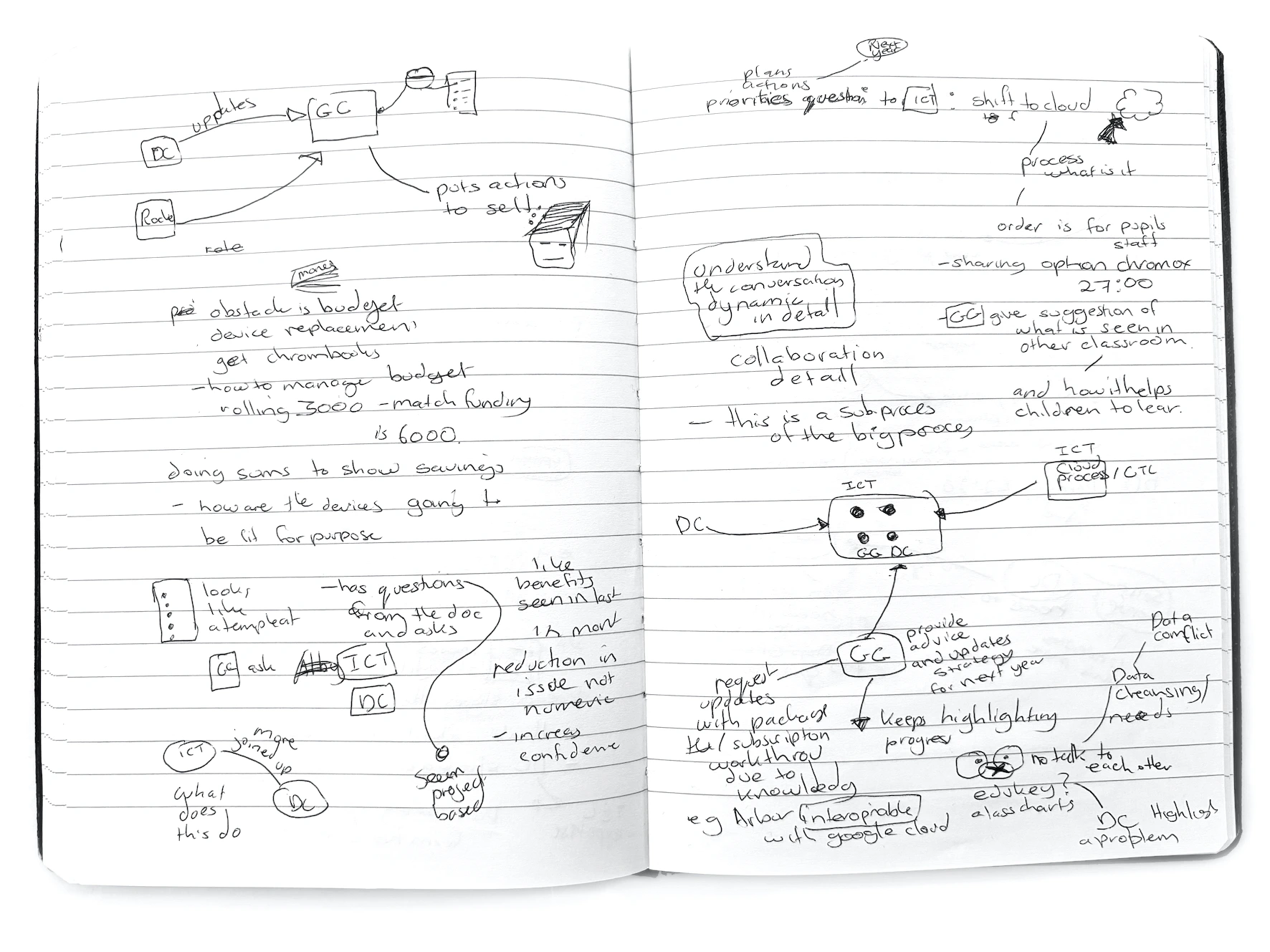
The on-site fieldwork was an immersive and comprehensive undertaking across the schools,
that used a dual approach of ethnography and contextual analysis.
(Note: This work
focuses on the research with the SouthEast cohort - see mitigating
sample loss).
The study followed a structured sequence: school tours and Q&A, observation of strategy and planning meetings, one-to-one in-depth interviews, and retrospective walkthroughs, remote workshop with three of the schools.
Organisational constraints
- Resource limitations were visible in the physical reality of rundown building interiors and / or exteriors.
- Server locations varied widely, from dedicated rooms to improvised spaces like a cleaner’s cupboard.
- Schools employed resourceful approaches to repurpose existing technology, such as installing Chrome OS on old Windows laptops.
Organisational priorities
- Urgent issues were context-dependent, reflecting where the school was on its digital maturity journey.
- Examples included the pressing need to ‘shift to the cloud’, the dilemma of choosing a productivity platform, or the urgency of meeting the DfE Digital Safeguarding Standard deadline.
Technical and non-technical roles in decision making
- Technical communication created a barrier, with non-technical roles relying heavily on IT expertise for sign-off.
- External IT advice could exacerbate issues when it did not align with a school's needs.
- Decision-making involved a mix of roles: Headteacher and / or Trust Lead and Finance Manager (non-technical leaders at key approval points), internal or external IT (technical roles), and the Digital Champion At each school, the Computing Lead had signed up for the Digital Champion apprenticeship as part of the Digital Innovation Programme and Change Consultant (acting as intermediaries).
Technology and environment
- Challenges were revealed in infrastructure and installation quality.
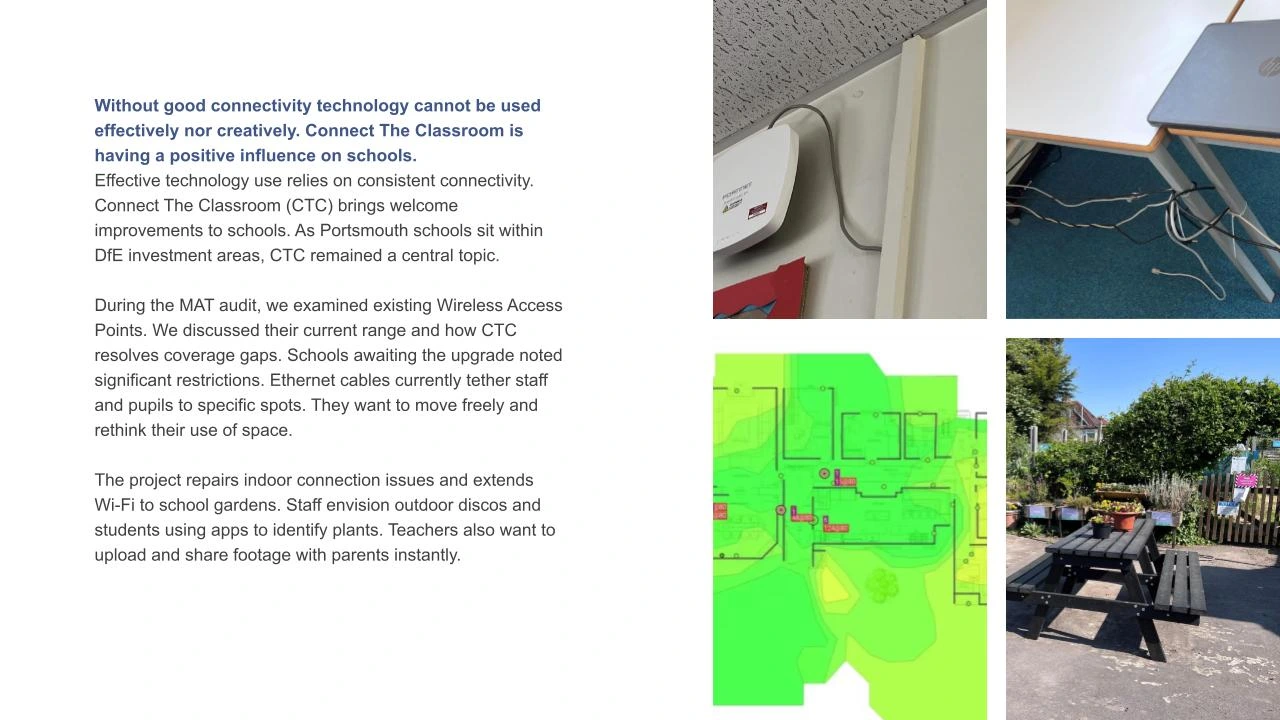
- Schools required wireless signal outside of buildings (for apps like Tapestry) and in hallways for student tuition.
- IT providers effectively used Wireless Access Point (WAP) heat maps as a visual audit tool.
- Evidence of poor installation quality, including a supplier failing to repair a classroom ceiling after installing new Wi-Fi cabling.
Data capture and debriefing.
- Handwritten notes were used for school tours and meeting observations, with double-teaming for retrospective walkthroughs to ensure accuracy.
- On-site sessions were valuable, as participants easily shared and referenced paper documentation and technology seen on the tours.
- Notes were compared at the close of each day to maintain focus and inform the direction for subsequent sessions.
Synthesis
As we moved into analysis, my project priorities shifted when I was scheduled to work on the research design for the Private Beta launch. This reduced the time to do an in-depth analysis.
To ensure the findings were still useful and actionable, we adapted the approach to prioritise approach to prioritise speed and direct communication. Instead of a full thematic analysis, I conducted a rapid, focused synthesis of handwritten observational notes, end-of-day reflection summaries, and draft interview scribes. This immediate synthesis allowed us to quickly move to actionable outputs tailored for each stakeholder.
To communicate the insights to the wider portfolio and the service team, we produced three core deliverables:
- Contextual report: A presentation to the wider portfolio highlighting the reality of resource challenges and technology management awareness—a perspective often missed in remote research.
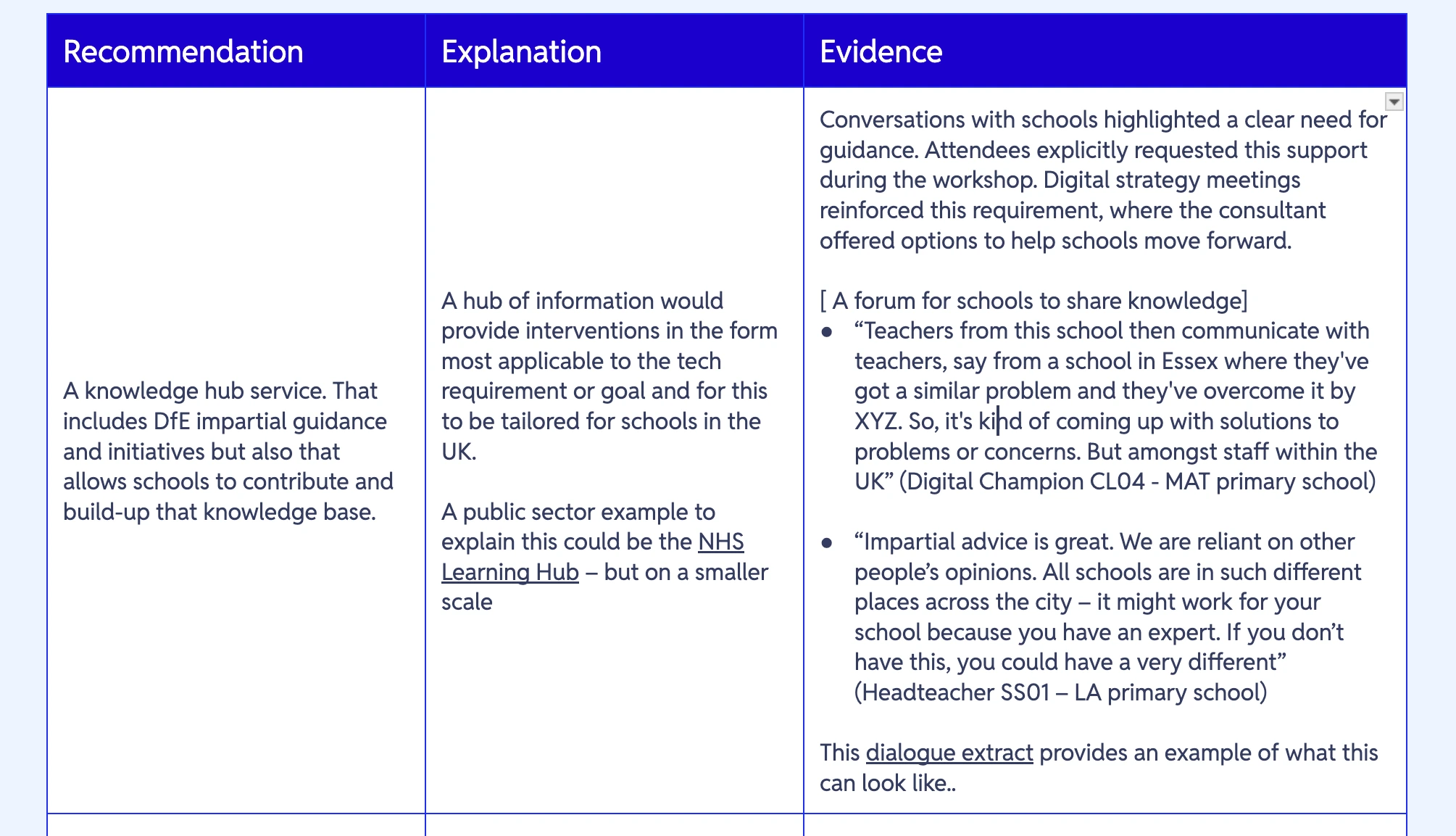
- Practical recommendations document: Findings were listed in a prioritised table with short-term and long-term considerations. To ensure immediate access, I replaced a formal presentation with a direct share, followed by one-to-one calls and asynchronous Q&A using the document's comment feature.
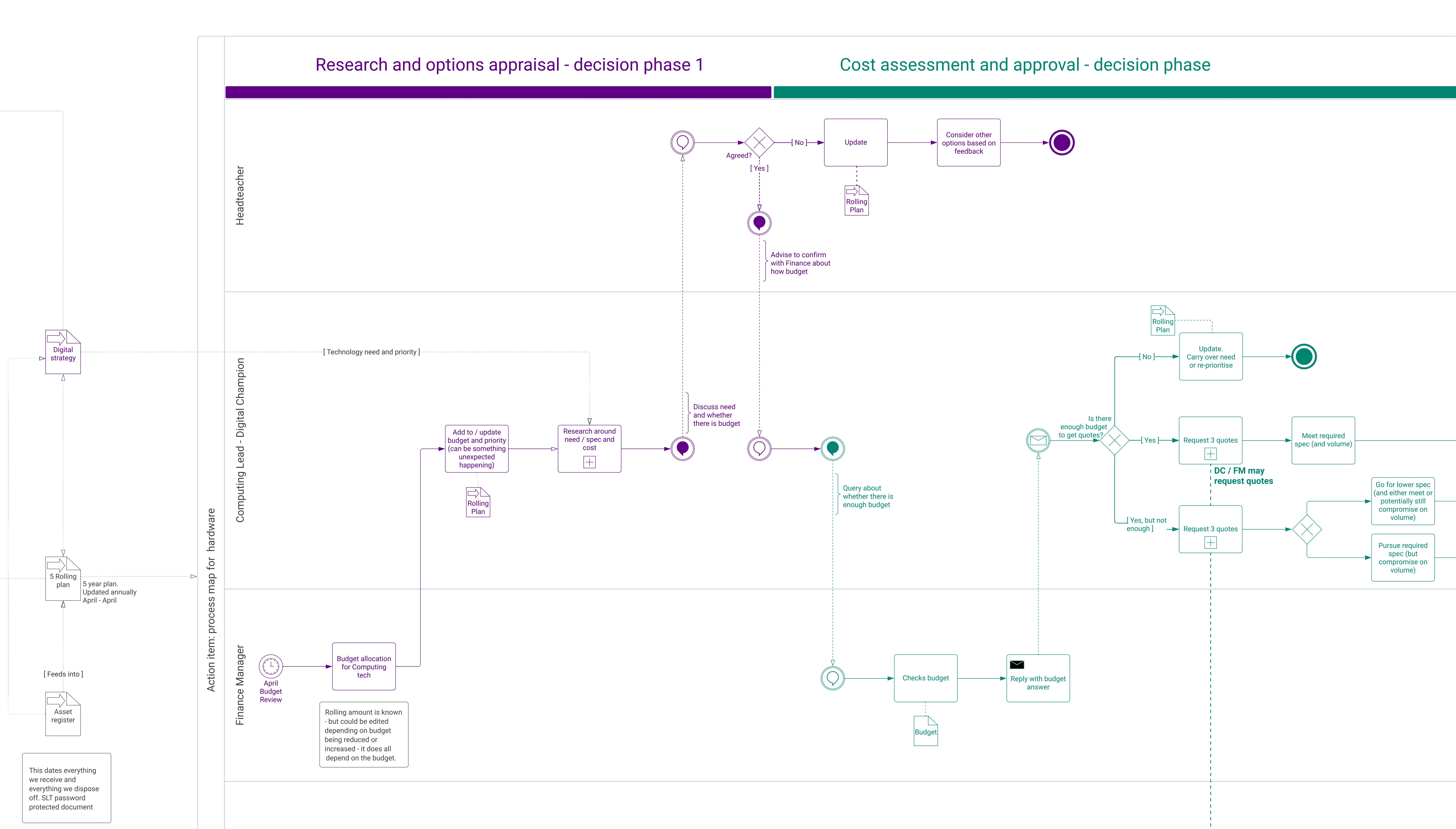
- Process maps: Synthesised from fieldwork, meetings, and retrospective walkthroughs, these maps used business process modelling to offer a clear overview of intricate workflows and decision-making processes.
Insights
Planning processes
The planning process is defined by the tension between pre-existing, operational structures and the introduction of a formal strategic process. Planning can be broken down into two distinct phases:
1. The Pre-Existing Operational Process (Reactive Planning)
Prior to external intervention, schools followed an internal, highly functional, but primarily reactive planning cycle that focused on asset maintenance and immediate needs.
- Assessment: Internal/External IT conducted annual asset registers and technical audits.
- Prioritisation: The Digital Champion or computing lead maintained a tech wish list with a breakdown of immediate needs and available budget.
- Execution: Schools had formal and informal action plans for maintenance and upgrades, and staff knew who to speak to for specific information, approval, and final sign-off.
2. The introduced strategic process (Vision-Driven Planning)
The key element missing was a comprehensive, long-term strategic vision. This was introduced by the Digital Change Consultant and was central to moving the school beyond maintenance.
- Strategic audit: The consultant introduced a formal digital strategy that required a comprehensive audit for technology use across three domains: children, adults, and all. This exercise was used to identify gaps and needs according to a new, shared vision.
- Strategy development: The consultant guided the development of a formal 2-year and 5-year strategy to translate the vision and audit findings into a sequenced, actionable roadmap.
- Execution support: The fieldwork demonstrated that the essential value of the Digital Innovation Programme was providing the necessary hands-on support to execute this strategy, train the Digital Champion, and unblock progress at key transition points.
Scroll to view full timeline

Key findings
1. Context over standards
Conversations focused on improving technology to meet DfE Digital and Technology standards seemed out of place when a few of the schools had more immediate and pressing infrastructure needs to address. Without funded DfE programmes like Connect the Classroom and device donations during Covid, meeting foundational standards for infrastructure would face an ongoing setback.
2. Role definition, inclusivity, and collaboration
The research uncovered a complex decision-making dynamic, confirming the necessity of broadening the service's focus beyond technical roles.
- Non-tech roles are central to key approvals: Headteachers and / or Trust Leads, and Finance Managers, are involved at key approval points.
- The Digital Champion acts as a key intermediary: The Digital Champion role is vital for advocating and driving the school’s technology vision. The Digital Champion forms the bridge between technical staff and non-technical leaders, translating complex needs into layman’s terms and aligning technical requirements with educational strategy.
3. Need for supported strategy and action planning
Schools require sustained, practical guidance to translate their technology vision into actionable strategy. The fieldwork and workshops highlighted the essential value of local, hands-on digital change consultancy (such as the Digital Innovation Programme) to actively assist in developing digital strategy, action planning, unblocking progress, and training an appointed Digital Champion to drive implementation.
4. Procurement risk and vendor reliance
External IT providers present a highly varied risk and opportunity to strategic decision-making.
- While some third-party providers could lead schools down a particular path regardless of the school's best interest, the research also observed external vendors strategically aligned with DfE Digital Standards who actively helped schools achieve their long-term goals.
Outcome
The primary outcome was a set of actionable insights that would have been missed without the on-site research. This new understanding of senior leadership's role directly influenced the service strategy and delivered impact in two key areas:
- Inclusion:
- Broaden role suggestions for each topic beyond just 'person responsible for IT'.
- Non-technical executive summaries to help secure buy-in for non-technical digital leaders.
- Strategic prioritisation:
- The development of Digital Leadership
and Governance
 , first for
the DfE Digital and Technology Standards and
then for the Plan Tech service - it included advice and guidance to appoint a
SLT Digital Lead / Champion and develop a digital strategy.
, first for
the DfE Digital and Technology Standards and
then for the Plan Tech service - it included advice and guidance to appoint a
SLT Digital Lead / Champion and develop a digital strategy.
- The development of Digital Leadership
and Governance
Reflection
- I learnt that when constraints require a design change mid-fieldwork (e.g., sample loss), be pragmatic. Focus on creatively adapting methods to capture the best possible data, rather than viewing the change as a loss.
- I learned to align deliverables with stakeholder workflows, moving beyond the
traditional lengthy slide deck to ensure insights were immediately actionable.
- Prioritised formats (like the recommendations document) that allowed for quick evidence-recommendation extraction and discussion.
- Confirmed the value of visual reports (e.g., process maps with business process modeling notation) over lengthy text.
Appendix
Classification of digital maturity
High Digital maturity
A strategic vision embedded in school planning; a cloud-first infrastructure ensures technology is seamless, sustainable, and consistently applied to enhance learning.
Medium Digital maturity
An inconsistent strategy often driven by a single enthusiast; a hybrid of cloud and legacy systems creates a divide where technology is used effectively in some classrooms but completely ignored in others.
Low Digital maturity
A reactive approach with no clear vision; heavy reliance on legacy on-site infrastructure which results in patchy Wi-Fi, and flexible working is difficult or impossible.
School sample
| Descriptor | Sch. 1 | Sch. 2 | Sch. 3 | Sch. 4 | Sch. 5 | Sch. 6 |
|---|---|---|---|---|---|---|
| Phase | Infant | Infant | Primary | Primary | Primary | Secondary |
| Type | LA | MA | MA | LA | MA | MA |
| Size | 176 | 345 | 479 | 288 | 562 | 1100 |
| FSM% | 15.9% | 14.2% | 19.2% | 39.9% | 34.7% | 23.9% |
| Roles | Phase of education | ||
|---|---|---|---|
| Inf. | Prim. | Sec. | |
| Headteacher | 2 | 3 | 1 |
| Finance manager | 1 | 2 | 1 |
| ICT lead (inhouse) | 1 | 3 | 1 |
| Digital champion | 2 | 3 | |
| ICT provider (external) | 3 | ||
| Total | 6 | 14 | 3 |