

Executive summary
Challenge: The Research section of the University's website was hindered by years of siloed content governance and an outdated Information Architecture. This structure limited key user groups from discovering collaboration and funding opportunities.
Research: I co-led contextual interviews and goal-oriented usability testing that first captured interests and goals and then assessed the site based on the contextual data. I applied systematic thematic analysis to manage a highly diverse user sample to generate the evidence base for the redesign.
Impact: The research informed the co-design of the Information Architecture and Content Strategy. The updated Research and Innovation section surfaces content that is relevant to external audiences. There has been a reported increase in user satisfaction.
Service overview
Digital Research communication at the university showcases strengths, facilitates new collaborations with partners, and supports the internal research community with resources on ethics, governance, and postgraduate opportunities. This content aims to attract funding, industry collaborators, world-class researchers, and prospective doctoral students to advance the university's research mission.
Challenge
The university needed to address years of siloed content creation and an outdated Information Architecture (IA) that prevented key user groups from discovering research and collaboration opportunities. To meet the business goals of increasing research funding, external partnerships, and doctoral applications, the project was commissioned to unify the entire research web presence.
My role and the team
As the UX Researcher in a three-person agency team, I was responsible for the research design, quality of data capture analysis and the reporting of user insights.
Collaboration
- Agency team: I collaborated with the Service Designer and Head of Design on the research methodology and to ensure the co-design activities were directly informed by the research findings.
- University partners: We partnered with the Digital Communications team and their UX function to align research with institutional objectives, engaging representatives from the IT team; the Research, Partnerships and Innovation team; and Research Communication officers.
Research design
Data that informed the research design
Personas provided a baseline: The university already had personas, which covered the key user groups as well as their goals and needs. This meant that we could map shared or common goals between user groups.
Project alignment workshop: I collaborated with my team to facilitate a full day workshop with university partners This included: the Communications team and their UX function; the IT team; the Research, Partnerships and Innovation team; and Research Communication Officers. to define the problem space and the research sample. There was shared recognition of some challenges, and then distinct challenges for each team. The workshop revealed that teams were not collaborating and this restricted their efforts to solve or ideate together
University partner-team interviews: I conducted follow-up interviews with each university team to get more detail about their role in digital research communication, and the challenges they experienced.
Overarching question
The research was designed to answer one central question:
How
effectively does the Research section of the website meet and support the goals of key
user groups?
Objectives
- Elicit priority goals for user groups
- Evaluate whether the site supports task completion and goal achievement
- Determine the systemic causes of user friction.
Methodology
Evaluative research
I selected an evaluative methodology that focused on goal-oriented tasks rather than on prescripted ones. Given the variance of user groups and objectives, this approach was necessary to capture the emergent nature of how they search and engage with content
Session structure: To address this, I structured the methods so that the usability test was derived directly from the interview data.
- Contextual interviews: To understand the participant’s role and identify their current and ongoing goals.
- Goal-oriented usability testing: To test the site against genuine goals or needs rather than hypothetical ones.
Sample
Original Plan: The research plan proposed a sample of 15 participants across 5 key user groups: Industry Collaborators / Partners, Funders, External Academics, Doctoral Students, and Collaboration Facilitators.
Final sample: Due to time constraints (coinciding with the summer holidays) and an additional request to speak to a few internal roles, we had a final convenience sample of 12 participants. This highly diverse sample, covering 8 distinct job roles, presented a challenge for the analysis and research quality.
Participant Breakdown (12 total, by job role):
- Commercial partners: 1 Fund Advisor, 1 City Stakeholder, 2 Industry Collaborators.
- Academic community: 2 External Academics, 2 Internal Academics, 1 Research Communication Officer
- Emerging talent: 1 PhD Applicant, 1 PhD Graduate.
- Internal facilitators: 1 Collaboration Facilitator.
Evaluative research
Key observations
Information architecture and discovery
- Search relevance: The website’s search feature failed to output relevant results for specific terms (e.g., ‘pipe stress analysis’ or ‘deep learning’). Instead, the search results linked to unrelated departments, academics, or general news items.
- Navigating the internal structure: The A-Z of research units did not surface expected results. For example, an External Academic who knew there was an ‘Obesity’ research group.
Content quality and focus
- Assessing academic profiles: Department staff directories lacked essential data such as job titles and specialisms. This created guesswork to decide who to contact.
- Audience targeting: Research content prioritised theory and did not cover the practical application or the ‘bottom line benefit’ that Industry Collaborators and Funders were looking for.
- Call to actions: The 'Collaborate with us' section contained a generic 'Meet the team' list. Industry collaborators could not find information on how to initiate a partnership or develop new products.
- Visibility of opportunity: The omission of post doctoral opportunities or fellowships in research groups or departments prevented a PHD Graduate from considering the university as a potential employer, while the obscurity of funding opportunities forced a PHD Applicant into a click-through process to determine career viability.
Synthesis
To ensure the data was actionable despite the low participant count per role (N=1 or 2), I moved away from analysing by job role. Instead, I synthesised using the four goal-oriented groups:
- Commercial partners (3 participants): Funders, Industry Collaborators and City Stakeholders seeking opportunity to collaborate with specific expertise.
- Academic community (5 participants): Internal and External academics seeking peer collaboration and reputation signals. As well as Research Communication Officers seeking to translate research complexity into accessible content for external engagement.
- Emerging talent (2 participants): PhD Applicant and PhD Graduate seeking supervision and post-doctoral opportunity.
- Internal facilitators (1 participant): Collaboration Facilitator supporting the research ecosystem.
Segmenting data solely by user group would have yielded thin, anecdotal evidence. I chose a systematic thematic framework to map insights for the goal-orientated groups.
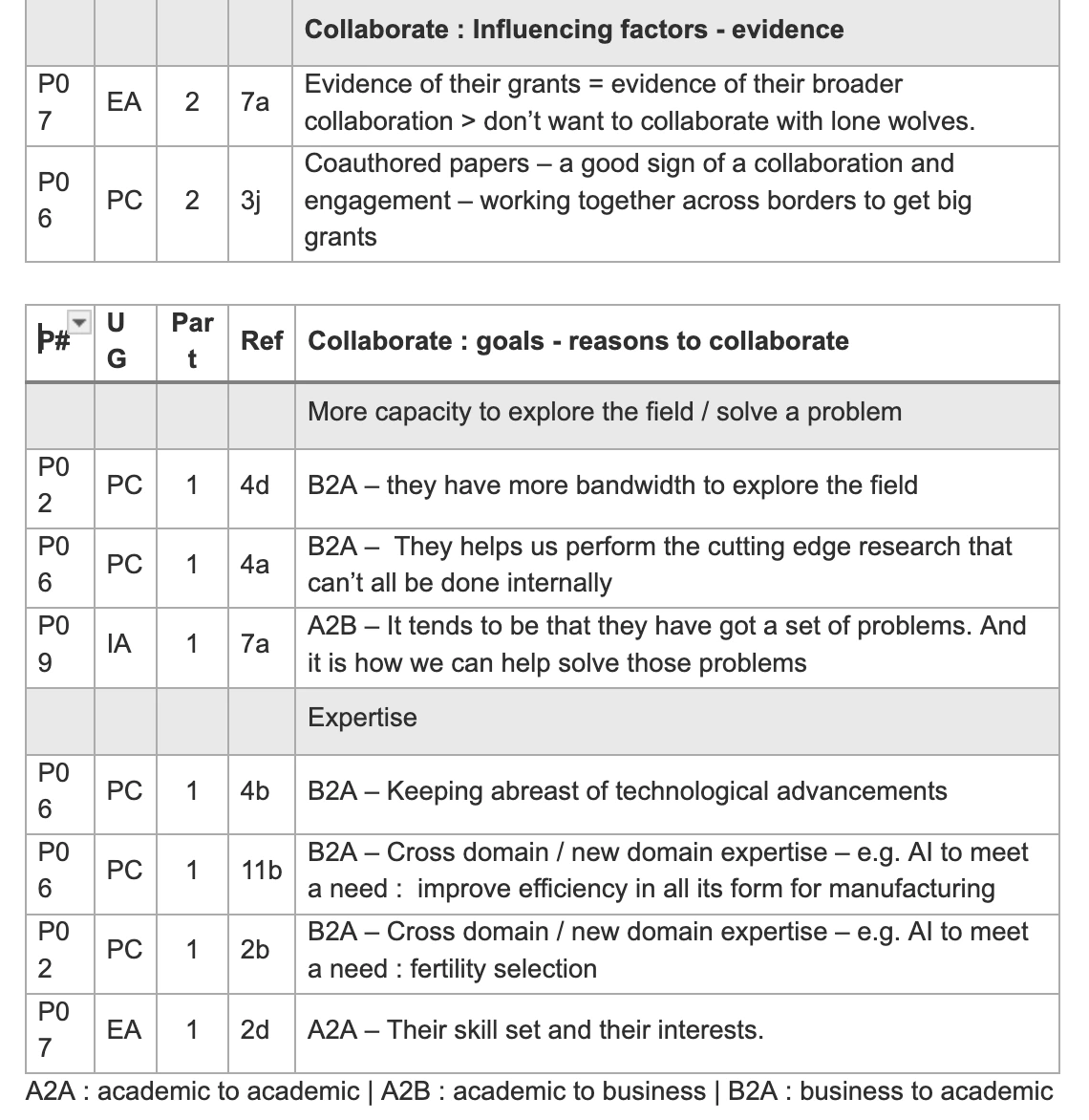
- Thematic matrix: I coded data by each group and assigned unique reference IDs to every finding. This ensured that all high-level insights were traceable back to specific evidence in the raw transcripts.
- Analysis split: I separated the analysis into three distinct layers to
support different streams of work:
- Decision themes: I mapped the influencing factors, such as funding availability, academic reputation or commercial alignment, that determine if a user chooses to engage.
- Goal themes: I defined the specific user intents, such as finding expertise to support a business enquiry or locating a PhD supervisor, which determines the content they needed to find.
- Interaction themes: I catalogued the functional barriers, such as irrelevant search results, ‘dead ends’ and navigation by internal structure, that prevented users from achieving those goals.
Insights
Decisions
- Validating the potential for a working relationship: Academic profiles are an influencing factor when deciding to initiate contact. With text heavy biographies, little to no commercial context, no indicator to show availability to collaborate, no call to action makes it difficult to decide if an academic is a potential fit.
- Evaluating commercial alignment and practical application: Commercial partners are interested in the bottom line benefit and practical application, yet the content prioritises theory, academic language and journal article formats. This approach fails to translate research into business value, and convert industry interest into active partnership.
- Judging departmental aggregated strength: External partners can't see the aggregate strength of a department when making decisions. Research outputs (e.g., total grants, research papers) are isolated on individual academic profiles. This prevents departments from proving their value and size to ranking bodies.
Goals
- Locating specific cross-faculty capabilities: External partners visit the site to find expertise in broad topics (e.g., Climate Change or Social Inequality). The Research Themes page groups content into a few broad, ambiguous categories. Because research is not collated across faculties into recognisable topics, participants assume the university is inactive in this area.
- Assessing research opportunity and career viability: Prospective Doctoral students aim to validate research quality and funding opportunities, yet the site prioritises metrics around number of registered students and obscures funding status. Similarly, early-career academics cannot assess the university as a potential employer because research group pages do not list post-doctoral vacancies or fellowships.
- Identifying real-world impact beyond teaching: City Stakeholders visit the site to identify the university's societal contribution. However, the content strategy prioritises ‘selling degrees’ over promoting research impact and emerging start-ups. This results in a narrow top-level architecture that restricts the discovery of innovation and case studies.
Interactions
- Organisational structure blocks discovery: The Information Architecture (IA) mirrors the university's internal hierarchy. This creates a barrier if external users do not have prior knowledge of schools, departments, and research groups to locate expertise.
- Decentralised governance creates dead ends: Siloed content management has resulted in a web of unmaintained microsites and broken links (404s). This fragmentation severs pathways to active research groups and undermines the university's credibility as a modern digital entity.
Outcome
Informed co-design: The research findings were the primary input for a two-day co-design workshop with the university teams. I acted as the user advocate during ideation and wireframing, referencing insights to ensure the new designs addressed the navigation and content barriers we identified.
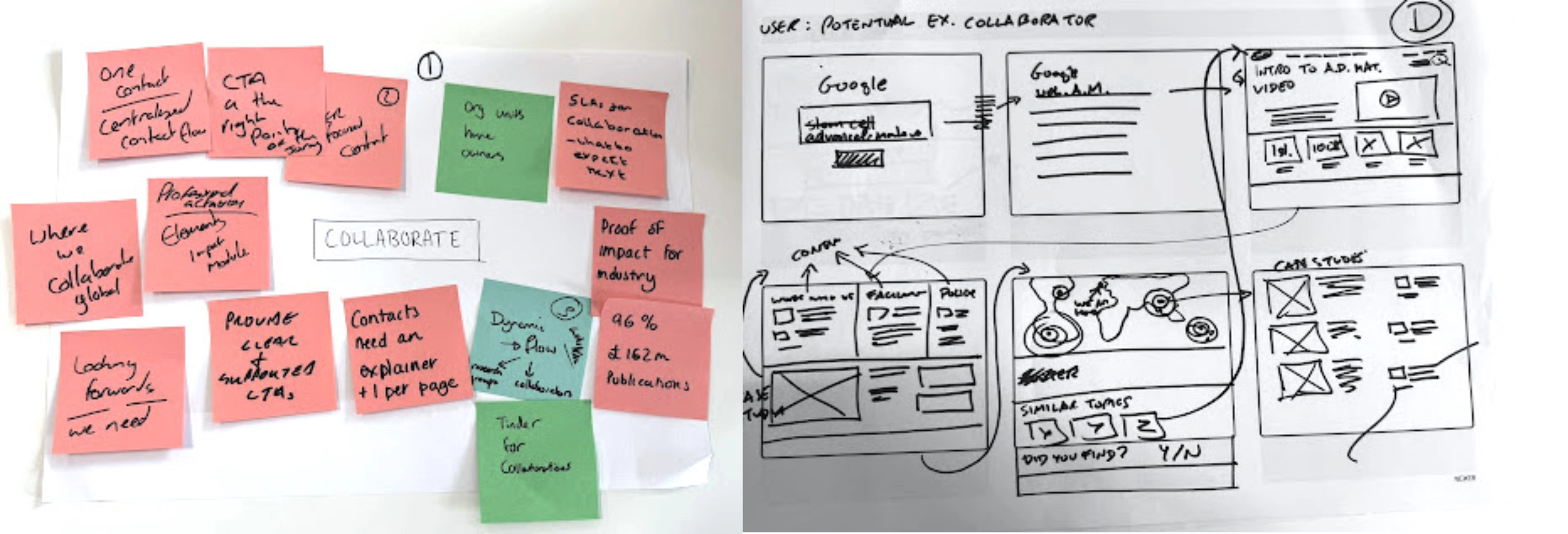
Defining the new direction: The co-design workshop with the Digital Communications team, and members of the IT, and Research, Partnerships and Innovation team, established a shared vision and defined a new direction for the service. It confirmed that the site's architecture needed to shift from reflecting internal university hierarchies to prioritising user intent and discovery to meet external needs. The research report and co-design recommendations were handed over for the UX function to develop the final Information Architecture and Content Strategy. In terms of collaboration, the planning and mixed-seating arrangement of the workshop showed each team the strength of what they could achieve if they put their heads together.
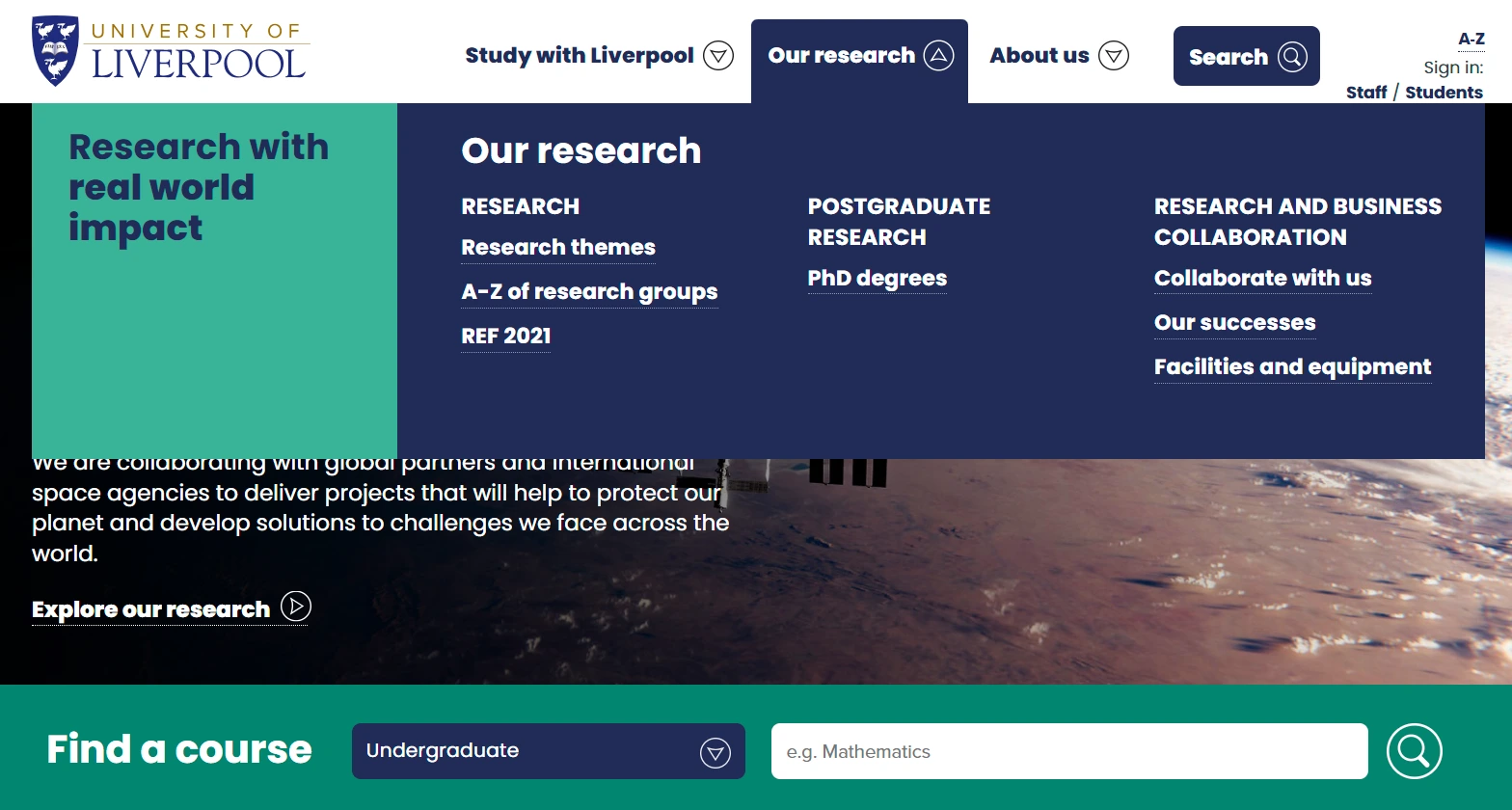
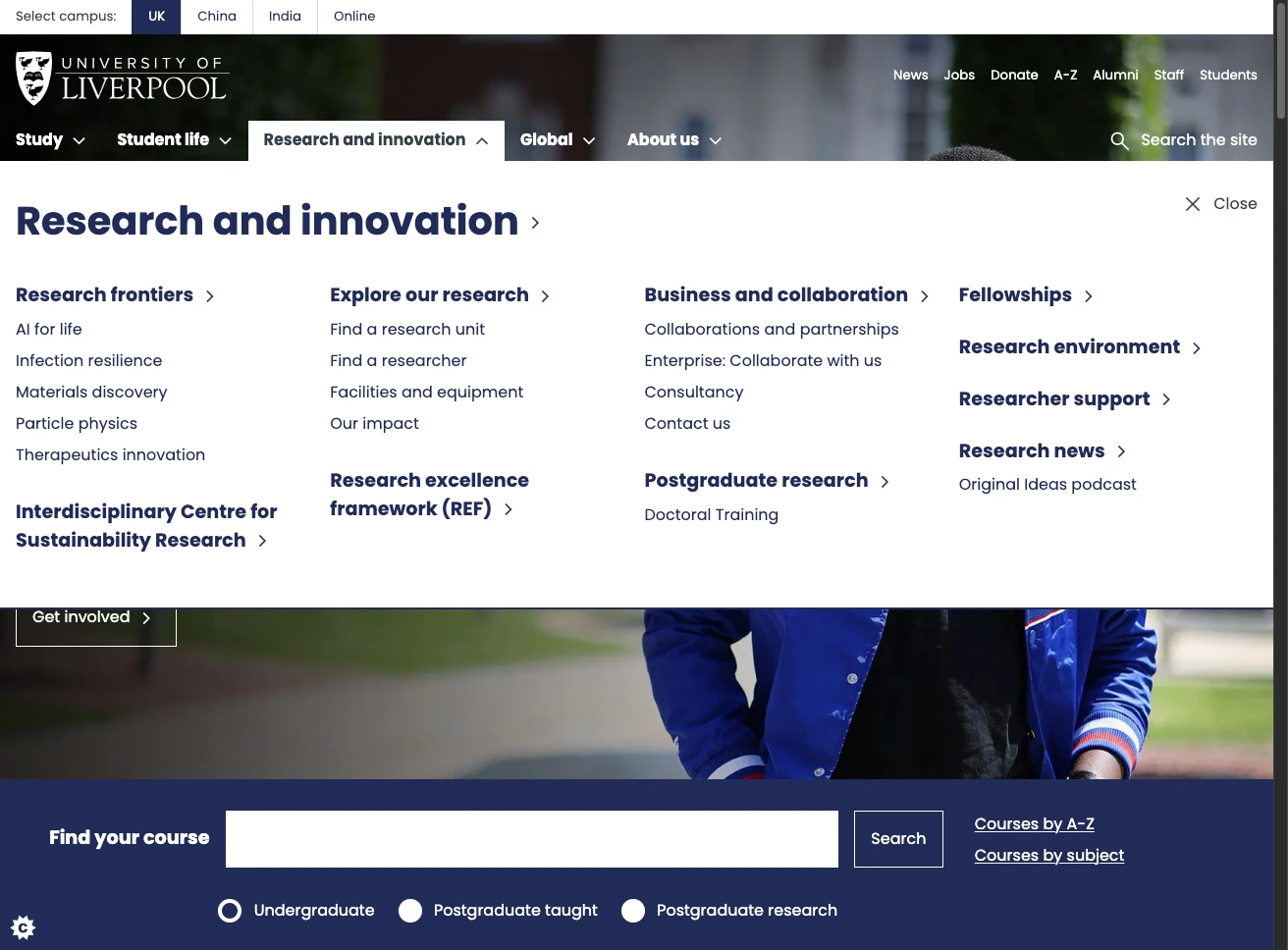
Implementation and impact: The university has since published an updated Research and Innovation section. They have reported increased user satisfaction with the new experience.
Reflection
The original plan of 15 participants across 5 user groups presented a risk to the reliability of the results. I raised the concern within my team, recommending a narrower scope that would focus on commercial partners (Industry Collaborators and Funders) and possibly include External Academics, and in a sense prioritising the universities objective to increase funding streams and industry partnerships.
The final decision was to retain the diverse sample and as diversity expanded during recruitment, I knew that I had to come up with an alternative approach to analysis, which would still generate insights to inform design and recommendations. The new approach was based on patterns mapped from the personas and from what was emerging during the sessions. I did learn that in situations where there is high functional diversity, you can identify patterns when you group according to a common goal or interest.